



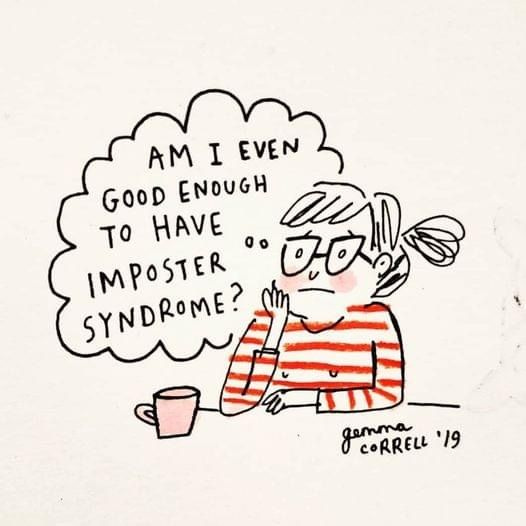
Growing up, I often felt like I did not deserve to be in the room I was in. Often, because I was so young and thought everyone else was smarter and wiser. “How did I get here?” “I’ll just make myself small because I’m the youngest in here, I don’t deserve to speak up.” Until I learned something called Imposter Syndrome.
I was not the only one. In fact, it’s a very common phenomenon. Research suggests that up to 70% of people will experience these feelings at some point in their lives. It is particularly pervasive among high achievers at the top of their fields; for them, the more they accomplish, the more they feel like they are simply standing on a house of cards.
This disconnect between external success and internal worth is exactly what led me to Juliette Ryan.

Juliette is an independent researcher with a PhD in engineering who has published numerous papers and received prestigious awards. Yet, for years, she lived with the same quiet dread. She assumed she was just “gaming the system,” a feeling that eventually led to a total burnout. That breaking point became her catalyst: she pivoted into neuroscience to understand the “first principles” of the brain and dismantle her own anxiety.
Today, Juliette is helping us understand that Imposter Syndrome is a deeply-seated neurochemical prior, not just low confidence.
Here is the science behind why we feel like frauds, even when the evidence says otherwise.
1. The Installation of “Conditional Self-Worth”
Our brains operate on “priors”, predictions based on past experiences. For many high achievers, these priors are installed in childhood.
When well-meaning parents praise outcomes (the grade, the trophy, the “good child” label) rather than the process, they inadvertently create a core belief: I only have value when I am achieving.
This creates a “Perfection Ceiling.” If 100% is the baseline expectation, there is no room for a “positive surprise” to boost our self-worth. There is only the catastrophic drop that happens when we hit 99%.
2. The Survival Logic of the “Dopamine Dip”
Why does a minor critique feel like a life-or-death situation?
In our evolutionary history, social ostracisation was a death sentence. To keep us in line, our brains developed a high sensitivity to negative feedback.
When we receive a negative evaluation, two things happen in rapid succession:
A Dopamine Dip: Our reward system shuts down.
A Noradrenaline Spike: Our stress response ignites.
Because the brain weighs negative feedback more heavily than positive feedback, we process a small mistake as a “dire threat” to our social standing. For someone with Imposter Syndrome, this neurochemical reaction confirms our deepest fear: I’ve been found out.
3. Resolving the “Fraud” Dissonance
Imposter Syndrome is essentially a math problem the brain is trying to solve.
The External Data: Everyone thinks I’m brilliant and capable.
The Internal Data: I feel worthless and anxious in the gaps between my achievements.
To resolve this mismatch (cognitive dissonance), the brain looks for the most logical explanation. It doesn’t conclude that it’s being too hard on itself; it concludes that it has tricked everyone.
This is why high achievers often underplay their success. They credit luck, timing, or “gaming the system” rather than their own competence. It is a protective mechanism to keep the internal and external worlds aligned.
4. Selective Evidence Collection
Once the “I am a fraud” prior is established, the brain becomes a biased detective.
It actively latches on to minor mistakes as evidence of unworthiness while dismissing broad successes as outliers. We aren’t just feeling like frauds; our neural pathways are actively filtering out any evidence that suggests we are actually capable.
What I’ve learned
Imposter Syndrome is real, and it’s not a personality flaw. If anything, it’s a conditioned response. Our brain is following a “prior” that links our value to our output.
By understanding how our brain works, I am reminded that this is not a permanent state.
The brain is neuroplastic, these “priors” are not set in stone. Just as we once learned to link our worth to our grades, we can unlearn it. We can dismantle the survival logic that treats a mistake as a threat and rewire our brains to collect evidence of our actual competence.
If you’ve read it this far, you’ve taken the first step towards dismantling Imposter Syndrome. Understanding the “why” will make the “how” easier.
In our next article, Juliette will walk us through the neuroscientific tools to rewire these patterns and separate our self-worth from our output.
Super interesting! Loved hearing the WHY on something so many people have.
Loved the insight into imposter syndrome from a neuroscience lens. There are legitimate reasons we feel this way ♥️