


Most of us were raised to believe that being ‘helpful’ is the mark of a good person. We spent years mastering the art of giving, but never learned the survival skill of taking.
In a corporate environment that values transactions over kindness, how far does being helpful actually take you?

The story of a dangling carrot
I entered the new fiscal year riding the high of a stellar performance review. I’d just landed the biggest bonus of my career, and being the most senior person on the team, I was told I was “in line” for a promotion.
To get there, my manager said I needed to take on tasks outside my scope for visibility. I was excited to say the least: I got to be helpful AND get promoted? This was my song.
For the rest of the year, I went all in. The critical mistakes that weren’t mine were fixed, stale office politics were mediated, new joiners were mentored, and events were MC’d just for the fun of it.
By the next performance review, I walked into the meeting room, chin up, ready to present. I listed all of it: every credit, every fix, every time I was being visibly helpful. I finished my closing statement and waited for the validation to come in.
Instead, what I got was a 3% raise and a shrug.
🤷🏻♀️: “Sorry, we don’t have the budget to promote you this cycle. And honestly, the hierarchy doesn’t allow for it right now because we’re a flat organization, as you know.”
Livid, my heart started pounding in my ears. “WHAT DO YOU MEAN? WHY DIDN’T YOU SAY THAT LAST YEAR?” That’s what I wanted to scream.
But all that came out was: “Oh, okay. I understand.”
I went home, cried, and blamed the culture, the politics, everything. But once the heat faded, I realized:
I’d been playing the “helpful” card all wrong.

It’s all business, baby
I’m going to hold your hand when I say this:
In the corporate world,
“helpfulness” is often unpriced labor.
There’s a concept called Non-Promotable Tasks (NPTs) that I’ve recently came across. These are the “office housework”: tasks that matter to the organization but do nothing for your career advancement. NPTs keep the lights on, but NPTs don’t get you significantly noticed.
And the kicker: research shows that women spend about 200 more hours per year on these tasks than men do.
But this is not about gender. This is about being strategic.

If I knew then what I know now
Looking back, I realize I shouldn’t have just nodded when I was told to seek “visibility.” I should have stopped and asked for clarity: what does it mean to be promotion-ready? And then, I can turn that vague advice into a real roadmap, one that I can follow up on at every 1:1 meeting. Growth should be clear, not a dangling carrot.
I’ve also learned that being “unhelpful” and “rude” are not the same thing. In my personal life, kindness is simple. But in a corporate setting, kindness needs to be contextualized.
Before I jump into fixing a mistake that isn’t mine, I need to pause and ask: What is the return on this effort? If a task doesn’t move the needle for my own growth, I owe it to myself to allocate that energy elsewhere.
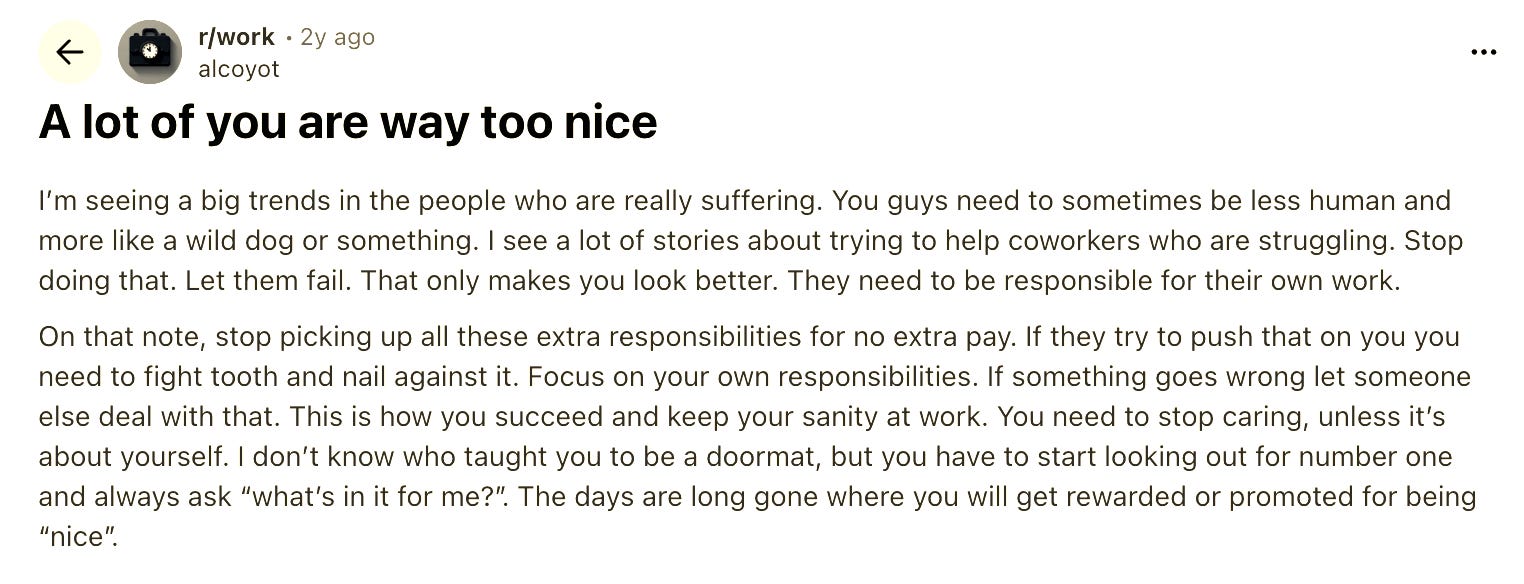
The intention to be helpful was never the problem.
I’m not “wrong” for being a kind person, and I don’t intend to stop. But I’ve learned that corporate systems aren’t built for kindness; they’re built for results.
I had to learn the strategy: be helpful to yourself first. Because only then can you effectively build up everyone else.
It’s all business, baby. 💙

Oof! This definitely hit home. I remember specific projects and tasks that I have volunteered for, put in my all, and didn’t get any reward or even recognition. I see others (especially women) in my industry doing the same and then becoming disappointed when it’s not recognized or factored into promotion. Especially when leadership talks about the value of those types of contributions. When I raised a concern over a male’s promotion because I did not see him making those types of contributions leadership responded that it wasn’t a part of the promotion decision - even though previous women on my team a year earlier had been held back from promotion because they were not “visible” enough. I do think there can be somewhat of a double standard for men and women.
I recently sent out a 360 degree feedback form to my colleagues (at all levels) and the most common response from people at the same level or below me (in terms of hierarchical structure) was “Chris takes on too much to try to be helpful” - so this was like having a speaker pointed at my soul