



Women are frequently socialized to be the “helpers.” The ones who smooth over office tension, take the notes, and organize the culture. We are rewarded for being reliable, yet that reliability comes with a steep price.
Nicole realized she had been conditioned to believe that being “always on” and slightly dysregulated was just a synonym for professionalism.
“Workplaces thrive on dysregulated women because they are the most productive.” They are the "culture glue" that keeps everything running at the expense of their own health.
But are you being strategically positioned by being helpful?

Dysregulated women are workplace heroes
Nicole Johnson was a striving leader in big tech. Carrying 27 years of experience, she built teams, mentored individuals, and delivered results at companies like Target, Best Buy, and Amazon. She was the ideal career woman and everything a leader should be. At home, Nicole was a dedicated solo parent to her “medically complex and awesome” son, providing constant care through heart surgeries and recovery.
In October 2024, she had been pushing through an intense season: navigating layoffs on her very first day and managing a team through high-stakes uncertainty. The stress of it caused her body to react: insomnia, “spinning” thoughts, and one day, she woke up with shingles on the side of her face. As the high-performing leader she is, she still showed up for the next meeting.
Only when a colleague looked at her and said, ‘Nicole, you need to take time off,’ did she finally allow herself to stop. That external validation was the permission she needed to finally rest.
Also read:

The “Drop More, Hold Less” Philosophy
After a four-month leave of absence, Nicole returned to work expecting a different outcome. Although she had rested, her environment remained the same. The “spinning” thoughts and insomnia returned within two months. She finally realized that the environment was toxic to her health. That’s how she understood that she needed to resign.
Fast forward to today, Nicole is a coach who helps high-achievers thrive long before a physical breakdown. In our interview, I asked her: If you were to coach your past self, what would you have told her?
She told me it’s about breaking the link between our output and our worth. We over-give because we think being “useful” is our only value. Her new philosophy, “Drop More, Hold Less,” is a commitment to splitting our identity from our job title.
Here’s how to do it:
Two important strategies for high-performing women at work
1. Pause and take your time
“You are allowed to pause and think before making a decision.”
We often feel that we have to answer things directly. Whether it’s a question, favor, demand, request, or tasks, we have to say “yes” instantly to prove we are helpful. But being a strategic leader means reflecting before answering.
So Nicole suggested, before you take on that next “urgent” task, ask yourself:
Does this directly move one of my 1–3 core outcomes?
Does this increase my visibility or decision authority?
Does this protect or drain my non-negotiable capacity (sleep, family, movement)?
If the answer is “no” across the board, you aren’t doing “work”, you’re doing maintenance or emotional labor.
2. “No” is a full sentence (and a strategic one)
And when we realize we cannot or don’t want to take on a task that does not align with our goals, we can say no without damaging our reputation. Nicole suggests scripts that position you as a partner, instead of a bottleneck:
Script 1: The Priority Trade-off: “I can certainly take that on. However, my main priority right now is Goal X, which is tied to our quarterly targets. If I take this on, Goal X will be delayed. Which one would you like me to prioritize?”
Script 2: The One-Time Hand-off: “I’m happy to help with this task this time to get us through the hurdle. However, this isn’t a long-term fit for my role’s direction. Let’s look at how we can distribute this more effectively across the team next time.”
How to move forward: Your Decision Rubric
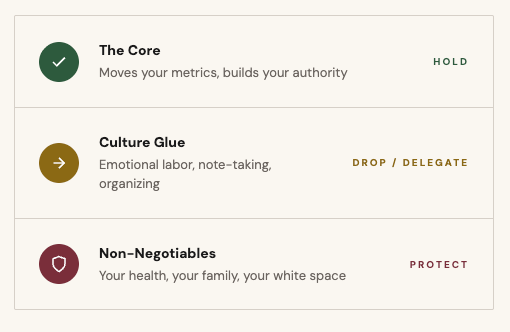
We often confuse being needed with being strategically positioned. Many women default to a “yes” that eventually may lead to burnout. To break the cycle of overworking, we have to create intentional “white space” to audit our to-do list. Nicole suggested we use this rubric to decide where our energy actually goes to:
I met Nicole for the very first time for this interview. In just 40 minutes, she shared empathy, inspiration, and strategic advice.
If I had met Nicole the coach a year ago, I probably would not have been here writing this article. I’d likely still be “enduring” a situation that was breaking me and trying to work through my own “helpfulness” trap. But I’m very glad to have met her now, so we can share these strategies with you, as we celebrate International Women’s Day together.
✨ Want to reclaim your focus?
If this article resonated with you, Nicole is offering limited free 50-minute Energy Audits the week of 16th March 2026. Join her to see where your capacity is actually going and how to stop the drain.
In the session, you will:
Map where your energy is currently going across work, emotional labor, and invisible responsibilities
Identify which tasks are truly strategic vs. “helpful maintenance” work
Clarify your non-negotiables so your capacity is protected
Leave with 2–3 concrete ways to reclaim time and shift toward more strategic contribution
If the sessions fill up, or you don’t find a suitable time slot, feel free to reach out directly to nicole@meny.me or message Nicole through Substack.
✨ Exclusive Free Gift for Healing Out Loud Subscribers
For Healing Out Loud readers, Nicole is also offering a complimentary discovery call if you’d like a few practical ideas on how to move away from default “helpful mode” and toward more strategic positioning at work.
I like your style, I need to read this.
I left my job (I know not financially sensible) but that was the only way I could say one big no instead of many small nos and heal my nervous system