



At 30 years old, I’m in the process of unlearning a lot of habits and beliefs that led me to burnout. One of them is Imposter Syndrome, a very well-known best friend to high performers.

So to understand it better, I approached Juliette Ryan, an independent neuroscience researcher with a PhD in engineering who uses neuroscience to “reverse engineer a better mind”. I asked her about Imposter Syndrome: what happens when we feel like a fraud, and how do we unwire it.

According to Juliette, to untangle a lifetime of linking self-worth to our output, we have to approach the problem from two fronts: the cognitive (the prefrontal cortex) and the limbic (the emotional, felt level).
Here are some neurobiological tools she suggested for dismantling imposter syndrome.
Part 1: The Cognitive Shifts, Calming the Prefrontal Cortex
Our prefrontal cortex (PFC) is our brain’s executive center that handles logic, planning, and objective processing. When imposter syndrome strikes, our emotional brain sounds an alarm, and our PFC gets hijacked by anxiety.
To keep our logical brain online, Juliette suggests three deliberate cognitive shifts:
1. Treat self-worth as axiomatic
High-performers usually view self-worth as something they have to earn every single day. If they have a productive day, their self-worth goes up; if they make a mistake, it plummets.
How we can shift this: Decide that our self-worth is axiomatic, a mathematical term meaning it is an established, self-evident truth that requires no proof. You don’t have to prove your right to exist or be respected; it is innate.
In layman’s terms: Your value as a human being is a basic, unarguable fact.
2. Shift to “Intrinsic Identity Statements”
When we define ourselves by external labels (“I am a successful manager,” “I am an expert”), we create fragile identities. The moment we make a mistake, that identity is threatened.
How we can shift this: Anchor our identity to our intrinsic values instead of status. Use internal statements like:
“I am a person who deeply values curiosity.”
“I am someone who cares about hard work and learning.”
These values are entirely within our control. No external assessment or bad day can take them away from us!
3. Reframe external feedback before reading it
When we receive feedback, our threat-detection system (the amygdala) often interprets criticism of our work as an attack on our personhood.
How we can shift this: Before we open an evaluation, look at metrics, or walk into a performance review, tell ourselves: “This data is about a specific project or metric. It is feedback on a task, not a grade on my value as a human being.”
If we feel the emotional “sting” of negative feedback, ask our PFC to do what it does best: analyze.
Ask ourselves objectively: “Is there a specific piece of data here I can learn from?” This simple question forces our brain to shift from emotional panic to problem-solving.
Part 2: The Limbic Shifts, Rewiring the “Felt” Experience
To truly quiet the imposter loop, we have to change how our bodies and emotional centers register safety and worth. This means gathering neurological evidence that we are safe even when we aren’t “performing.”
To do that, Juliette suggests a few things:
Praise the process, not the outcome
If we only celebrate when we hit a home run, our brain learns that only the final destination matters. In order to build resilience, we can start by intentionally praising our own efforts.
Savor unconditional love
Our brains have a high negativity bias; we quickly forget moments of safety and hyper-focus on threats. To counteract this, Juliette recommends looking for and “savoring” moments of unconditional love.
This doesn’t have to be a grand gesture. It can be your partner bringing you coffee without being asked, your child giving you a random hug, or even your pet being thrilled to see you when you walk through the door.
Let’s practice: When these moments happen, don’t just brush them off. Pause for 15 to 30 seconds. Feel the safety of being cared for when you are doing absolutely nothing to “earn” it. This builds real-time neural evidence that you have value simply because you exist.
Part 3: Memory Reconsolidation
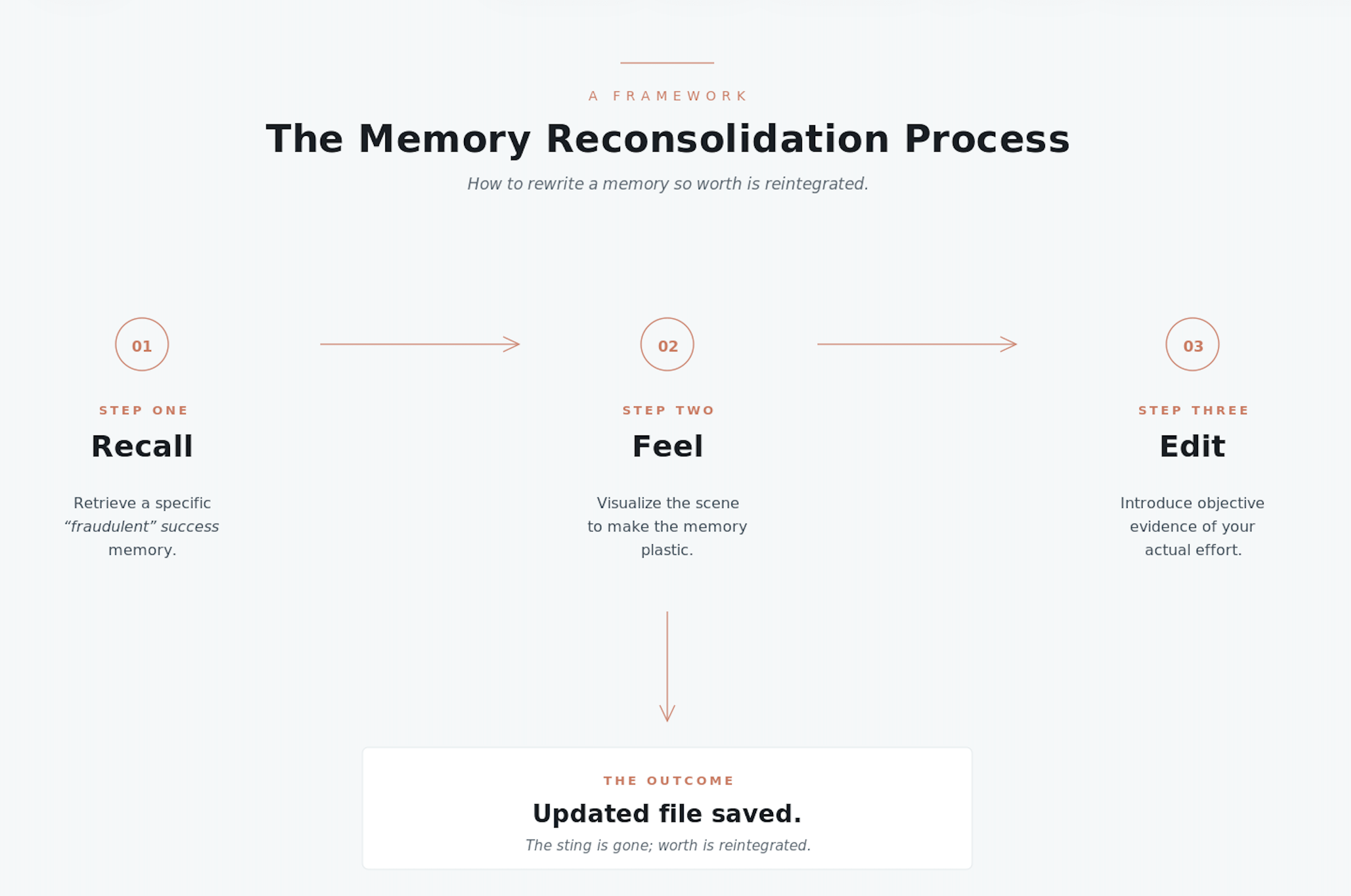
One of the most profound tools Juliette shared is a process called memory reconsolidation.
If you have a historical memory of success where you felt like a complete fraud, you can use this biological window of plasticity to “edit” the memory and restore it as an earned achievement.
5-Minute Memory Reconsolidation Exercise To Try At Home
We can practice this exercise daily to systematically update our history of “fraudulent” wins.
Retrieve the memory: Think of a specific moment of success from your past where you felt like a total fraud (e.g., getting a promotion, receiving an award, graduating, or delivering a highly praised presentation).
Engage with the context: Close your eyes and fully visualize the scene. Where were you standing? What was the lighting like? Who was there? Allow your brain to bring up the original emotional context. This step is crucial because it activates the hippocampus and makes the memory “labile” (pliable).
List your earned evidence: While actively feeling that memory, write down (or list in your head) every single concrete action and instance of hard work you did to make that success happen.
Examples: The exact number of hours you spent researching at your desk, the edits you made late at night, the books you read, or the emotional energy you spent practicing.
Update the file: If your brain tries to tell you, “Oh, I just got lucky,” ignore the excuse and keep looking until you find at least one or two undeniable instances of your own effort. By introducing this factual evidence of your hard work while the memory is open and active, you physically rewire how that memory is saved.
The Result: Over time, the emotional “sting” of that memory will fade. Instead of feeling like a fluke, your brain will begin to categorize your past milestones as genuine, earned successes.
Personally, when Juliette shared this exercise with me during our interview, I was completely blown away. I realized this is why therapy and journaling help us recover and heal.

Small Steps to Unlearning Imposter Syndrome
Dismantling imposter syndrome won’t be overnight. Just because we know why it happened and how to unwire it, we can cure it by doing these practices once. It’s a journey on its own, and it requires repetition.
To summarize, Juliette suggests keeping these three micro-practices in your back pocket:
Morning: Frame your day with an intrinsic identity statement: “Today, I am showing up as a person who values curiosity and persistence.”
Throughout the Day: Notice moments of self-judgment. Gently interrupt them by asking, “Is this feedback about my worth as a person, or is it just a specific data point I can learn from?”
Evening: Spend 20 seconds savoring a moment of unconditional connection. Let your nervous system remember what it feels like to be valued simply for existing.
Imposter Syndrome is a common phenomenon in high achievers. The good news is, it doesn’t have to be, and you can change it.
Beginning this process can feel incredibly overwhelming, and it takes a genuine, daily commitment to mindfulness. The good news is, it gets easier the more we practice! This is not about achieving a flawless overnight transformation; rather, it is about the small, compounding efforts we make every single day.
I truly hope this article has helped open up some breathing room for you today.
If you have more questions about neuroscience or just want to share your own experience, feel free to reach out and contact Juliette directly on Substack!
The memory reconsolidation exercise stood out the most to me. The notion that you can revisit a past "fraudulent" win and consciously re-attach it to the concrete effort you put in. And that this actually changes how the memory is stored; gives the whole thing a hopeful, practical edge rather than just being feel-good advice. Thanks for sharing this, definitely saving it to revisit.